A lot of people know SanDisk from a tiny USB flash drive or a camera memory card. Founded in 1988 in California and headquartered in Milpitas, in the heart of Silicon Valley, the company spent more than three decades doing one thing: helping people store stuff. In February 2025, it split off from Western Digital and returned to trading on Nasdaq, stepping onto the global memory-chip battlefield on its own. Nobody expected that just over a year later, this company would become one of the most sought-after names in the AI boom.
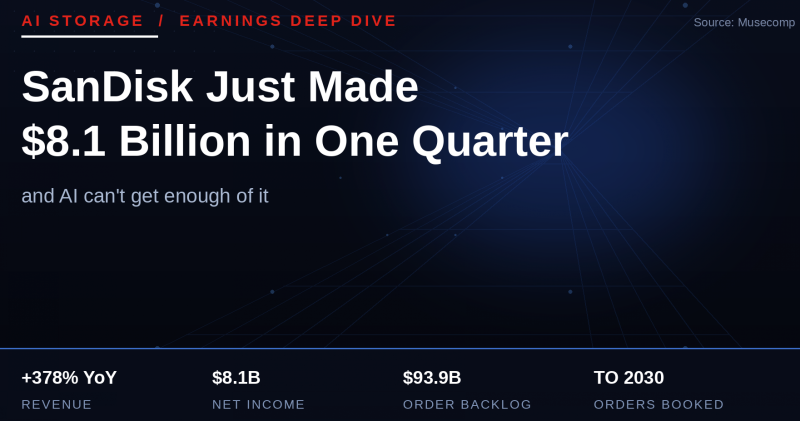
Start with a set of eye-popping numbers. On October 29, 2026, SanDisk reported its first quarter of fiscal 2027 (ended October 2, 2026): revenue of $11.031 billion, up 378% year over year and 23% quarter over quarter; GAAP net income of $8.101 billion, or $52.60 per share on a GAAP basis, and $49.51 per share on a non-GAAP basis; adjusted free cash flow of $5.7 billion. Zoom out to the full fiscal year 2026: revenue of $20.248 billion, up 175%, with net income of $11.433 billion — a year earlier, the company had lost $1.641 billion. In plain terms: it went from the ICU straight into the Olympic finals.
Where is the money coming from? Break it down: data center revenue hit $4.802 billion, up 61% quarter over quarter, making up more than 40% of the total — that's the real engine. Edge business (phones, industrial devices, and more) contributed $5.832 billion. Consumer revenue was $397 million, down noticeably quarter over quarter, and shrinking as a share of the mix. The structure reveals a big secret: SanDisk is turning from "the company that sells USB sticks" into "the company that supplies the AI data centers." To make the stock easier to buy, the company also announced an 8-for-1 stock split, effective November 19, 2026.
Why does AI suddenly need flash memory so badly? Here's a simple analogy: the GPU and HBM are AI's "desk," where the work in progress is spread out. Flash memory (NAND) is AI's "warehouse," where training data, model archives, inference logs, and user conversation context all pile up. As models get smarter, prompts get longer, and AI starts looking at images, listening to voices, and remembering context — the warehouse fills up at an explosive rate. On the earnings call, SanDisk CEO David Goeckeler said it plainly: "Customers underestimated how much flash storage AI infrastructure would need." Translated into everyday words: when you built your AI skyscraper, you miscalculated the size of the warehouse.
Even more striking are the orders. Over the past two years, SanDisk has been pushing a new business model called "NBM" — long-term agreements with major customers. The reported backlog under these long-term customer agreements has surpassed $93.9 billion, with orders booked beyond fiscal 2030. In a semiconductor industry that is famously at the mercy of the cycle, that's like pre-paying and locking the meal tickets for the next four to five years inside a safe. Management has even revealed that some customers are exploring the use of SLC flash to replace a portion of expensive DRAM for caching in AI inference — meaning the role of flash memory is still being redefined.
On the technology side, SanDisk genuinely holds a few strong cards. It has been partners for decades with Japan's Kioxia. The two jointly operate fabs (their collaboration agreement runs to 2034), and their co-developed BiCS 3D flash has reached its tenth generation. On July 3, 2026, the 332-layer BiCS10 began sampling: the layer count jumped 52% from the 218 layers of BiCS8, the interface speed rose from 3.6 Gbps to 4.8 Gbps, and it uses a CBA process that builds the logic circuits and memory arrays separately and then bonds them — an upgrade that doesn't require new fab lines. In August 2026, the two companies followed up with a next-generation QLC flash built on the same generation: bit density above 37 Gb/mm², roughly 60% higher than BiCS8 — the industry's first QLC flash to hit 4.8 Gbps, and officially described as the industry's highest QLC bit density. SanDisk has also showcased enterprise SSDs with capacities up to 256 TB, and it is developing "High Bandwidth Flash" (HBF) for AI inference — test chips have been taped out, with delivery slated for 2026. The goal is to play a new role in the AI data center: "fast enough, enormous in capacity, and far cheaper than DRAM."
Step back, and this is a party the whole industry is attending. Over the same period, Micron's quarterly NAND revenue surged 361% year over year — almost in lockstep with SanDisk's 378%. TrendForce data for Q3 2025 shows the global NAND market at Samsung 32.3%, SK hynix 19.3%, Kioxia 15.3%, and SanDisk 12.4% — together, the Kioxia-SanDisk team is already the second-largest force in the world. The two companies have also committed to investing over $31 billion in Japan through 2032 to expand AI storage capacity.
Of course, a cold shower is in order. Memory chips are a fiercely cyclical industry: the harder they soar, the harder they fall. A non-GAAP gross margin of 85% is "extreme weather" by any historical standard. After 2027, as fab capacity comes back, price declines are the more likely outcome — management itself keeps stressing respect for the cycle. Buying SanDisk is, at its core, a bet on two things: that AI-driven demand growth is structural, and that those long-term orders stretching to 2030 can turn peak-cycle profits into a higher profit floor.
From a memory card to the "memory warehouse" of the AI era, SanDisk's story carries a simple lesson: when the wave comes, catching it is not about who shouts the loudest — it's about how long you've been sitting at the table and whether you hold real cards in your hand. This company has been sitting there for thirty-eight years. And now, the wind has truly arrived.